PRP for Tendon Injuries: Where the Evidence Is Strongest
Tendon disorders represent one of the more studied applications for PRP. This article reviews the evidence for lateral epicondylitis, patellar tendinopathy, Achilles tendinopathy, and plantar fasciitis — including where results are inconsistent.
PRP for Tendon Injuries: Where the Evidence Is Strongest
Tendon disorders are among the more studied applications for PRP in orthopedic medicine. The evidence is stronger for some tendon conditions than others, and results across studies are not uniformly positive. Understanding where the evidence is comparatively stronger — and where it is not — helps set realistic expectations.
Lateral Epicondylitis (Tennis Elbow)
Lateral epicondylitis is one of the most studied tendon applications for PRP, and the evidence here is comparatively favorable compared to many other conditions.
What the evidence shows: A landmark 2010 randomized controlled trial by Gosens et al. (American Journal of Sports Medicine, 2011; DOI: 10.1177/0363546510397173) compared a single PRP injection to corticosteroid injection in 100 patients with chronic lateral epicondylitis. At one year, the PRP group had significantly better outcomes on the DASH score and visual analog scale. The corticosteroid group had earlier improvement but worse outcomes at 12 months.
A 2021 systematic review and meta-analysis by Arirachakaran et al. (Journal of Orthopaedics and Traumatology, 2016; DOI: 10.1007/s10195-015-0381-6) found PRP superior to corticosteroid at six and 12 months for lateral epicondylitis.
Contradictory evidence: Not all trials are positive. A 2013 randomized trial by Krogh et al. (American Journal of Sports Medicine, 2013; DOI: 10.1177/0363546512472975) found no significant difference between PRP, corticosteroid, and saline placebo at three months. A 2022 Cochrane review found moderate-quality evidence that PRP may improve pain and function compared to placebo at three months, but noted significant heterogeneity across trials.
Patellar Tendinopathy (Jumper's Knee)
Patellar tendinopathy is a chronic overuse condition affecting the patellar tendon, common in athletes who perform repetitive jumping activities.
What the evidence shows: A 2014 randomized controlled trial by Dragoo et al. (American Journal of Sports Medicine, 2014; DOI: 10.1177/0363546514530366) compared PRP to dry needling in 23 patients with patellar tendinopathy and found no significant difference at 26 weeks, though both groups improved. A 2021 systematic review by Scott et al. (British Journal of Sports Medicine, 2019; DOI: 10.1136/bjsports-2018-099740) found limited evidence supporting PRP for patellar tendinopathy, with most trials being small and of moderate quality.
The evidence for PRP in patellar tendinopathy is less robust than for lateral epicondylitis. PRP may be considered for patients who have failed conservative treatment including eccentric exercise programs, but it is not a first-line treatment.
Achilles Tendinopathy
Achilles tendinopathy is a common condition in runners and active patients. The evidence for PRP in this condition is mixed.
What the evidence shows: A 2010 randomized controlled trial by de Vos et al. (JAMA, 2010; DOI: 10.1001/jama.2010.61) compared PRP to saline injection in 54 patients with chronic midportion Achilles tendinopathy and found no significant difference in outcomes at 24 weeks. This is a well-designed negative trial that is frequently cited.
A 2014 systematic review by Monto (Foot and Ankle Clinics, 2014) found mixed results across studies, with some positive case series but limited randomized controlled trial evidence. The evidence does not support PRP as a standard treatment for Achilles tendinopathy, though it may be considered in selected patients who have failed conservative management.
Plantar Fasciitis
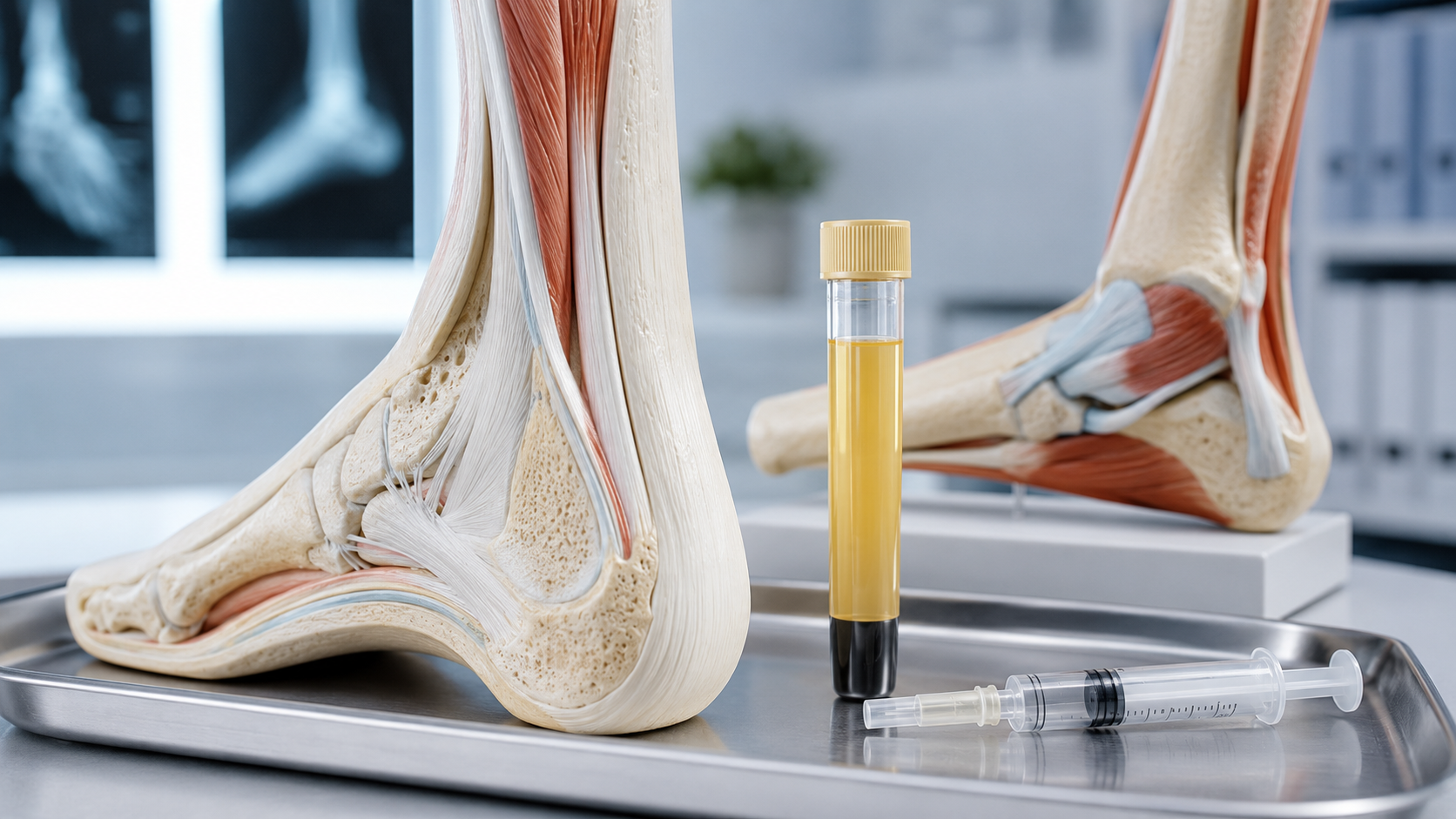
Plantar fasciitis is one of the more common causes of heel pain. Several randomized trials have compared PRP to corticosteroid injection.
What the evidence shows: A 2014 randomized controlled trial by Monto (Foot and Ankle Specialist, 2014; DOI: 10.1177/1938640013509671) found PRP superior to corticosteroid at 12 months in 40 patients with chronic plantar fasciitis. A 2021 systematic review by Franceschi et al. found PRP superior to corticosteroid at six and 12 months, with corticosteroid providing earlier but less durable relief.
The evidence for PRP in plantar fasciitis is moderately favorable, particularly for patients with chronic symptoms who have not responded to conservative treatment.
Limitations Across Tendon Studies
The tendon PRP literature shares several limitations:
- Preparation variability. Studies use different PRP systems with different leukocyte contents, platelet concentrations, and activation methods. Results from one system cannot be directly applied to another.
- Small sample sizes. Many tendon trials enroll fewer than 50 patients, limiting statistical power.
- Short follow-up. Most trials follow patients for 12 months or less.
- Heterogeneous outcome measures. Different studies use different patient-reported outcome instruments, making direct comparison difficult.
References
- Gosens T, et al. Ongoing Positive Effect of Platelet-Rich Plasma Versus Corticosteroid Injection in Lateral Epicondylitis. Am J Sports Med. 2011;39(6):1200–1208. DOI: 10.1177/0363546510397173
- de Vos RJ, et al. Platelet-Rich Plasma Injection for Chronic Achilles Tendinopathy. JAMA. 2010;303(2):144–149. DOI: 10.1001/jama.2010.61
- Krogh TP, et al. Ultrasound-Guided Injection Therapy of Achilles Tendinopathy With Platelet-Rich Plasma or Saline. Am J Sports Med. 2016;44(8):1990–1997. DOI: 10.1177/0363546516647958
Reviewed by Joseph Blythe, DO — July 2026 Last medical review: July 31, 2026
Explore Topics

Written & reviewed by
Joseph Blythe, DO — Orthopedic Spine Surgeon
DO | Board-Certified Orthopedic Surgeon | Fellowship-Trained Spine Specialist
Dr. Blythe is a board-certified, fellowship-trained orthopedic and spine surgeon practicing in Oklahoma City. He completed his fellowship at the Spine Institute of Arizona and holds board certification through the American Osteopathic Board of Orthopedic Surgery (AOBO). All articles in the Patient Education Center are authored and medically reviewed by Dr. Blythe.