
Knee
Total Knee Replacement Surgery in Oklahoma City
Total knee replacement (total knee arthroplasty) resurfaces the damaged ends of the femur, tibia, and patella with metal and plastic implants, restoring a smooth, functional joint surface. It is one of the most reliably effective procedures in orthopedic surgery for appropriately selected patients with end-stage knee arthritis.
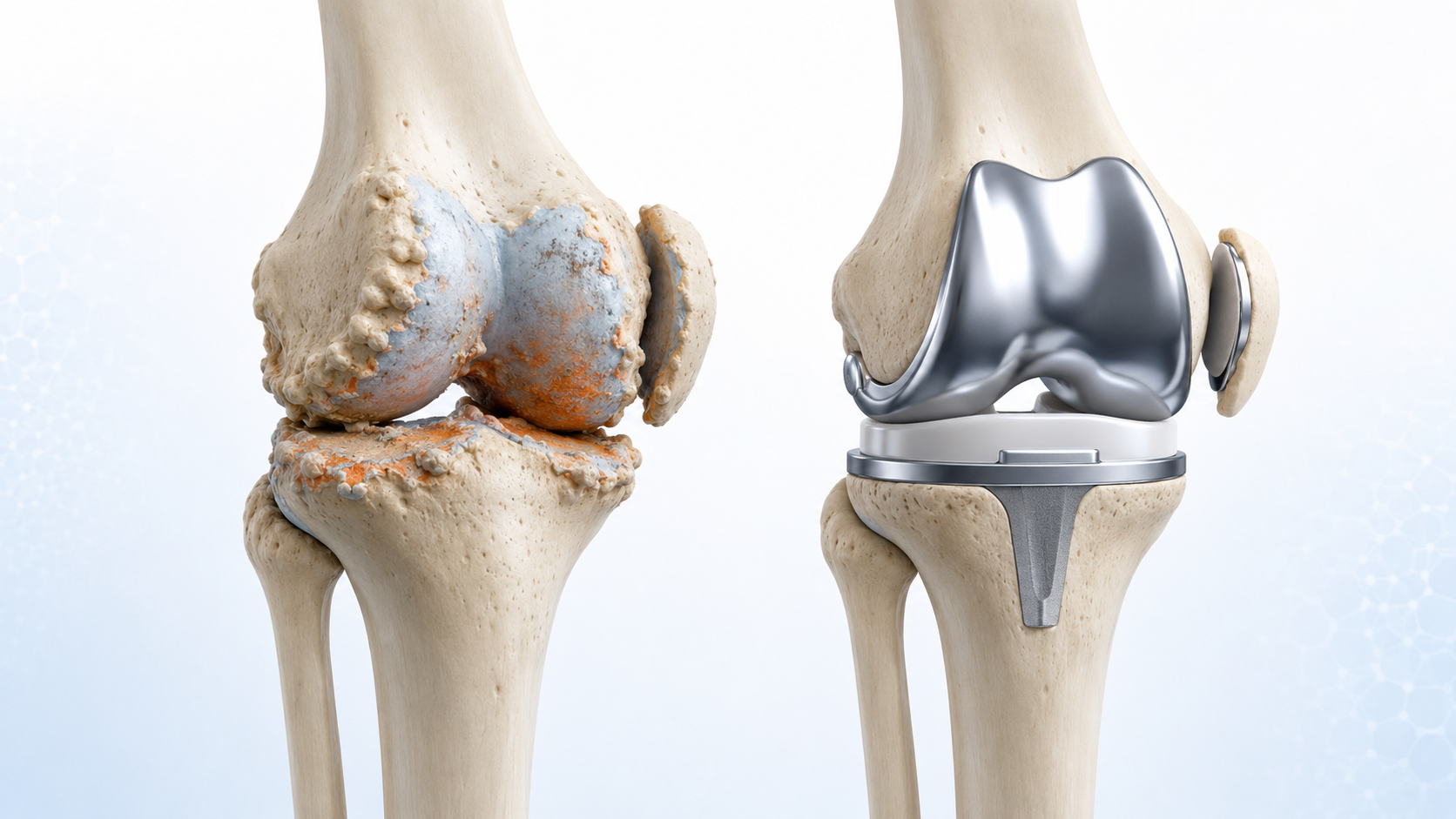
What this image shows
- The arthritic knee shows cartilage loss, joint-surface damage, and osteophyte formation.
- The replacement view shows generic femoral, tibial, polyethylene, and patellar components.
- Knee replacement is considered when advanced arthritis causes substantial pain and loss of function despite appropriate nonsurgical care.
Knee Replacement Surgeon in Oklahoma City
Patients searching for a knee replacement surgeon in OKC or asking "how do I know if I need a total knee replacement" are typically dealing with arthritis that has progressed beyond what injections and therapy can reliably manage. Dr. Joseph Blythe is a fellowship-trained orthopedic surgeon who evaluates and treats knee arthritis at his Oklahoma City practice — from early-stage management through surgical reconstruction.
The evaluation begins with a review of your X-rays and a thorough physical examination. Not every arthritic knee requires replacement, and Dr. Blythe will give you a direct, honest assessment of where you are in the disease course and what the realistic options are at your stage of arthritis.
Mild to moderate arthritis
Physical therapy, weight management, anti-inflammatory medications, and injections are the appropriate first line. Surgery is not indicated.
Moderate to advanced arthritis
Corticosteroid or hyaluronic acid injections, PRP, and activity modification may provide meaningful relief and delay surgery.
End-stage arthritis
When conservative measures have been exhausted and functional limitation is severe, total knee replacement offers reliable, durable pain relief.
Signs That Knee Replacement May Be Appropriate
- Persistent knee pain that limits daily activities
- Pain that continues at rest or wakes you at night
- Knee stiffness that makes it difficult to bend or straighten the leg
- Swelling that does not resolve with rest or medication
- Knee deformity such as bowing in or out
- Failure of conservative treatment to provide adequate relief
Conservative Treatment First
Surgery is considered only after conservative treatment has been given a reasonable trial. Options include:
- Weight loss to reduce joint load
- Physical therapy and strengthening exercises
- Anti-inflammatory medications
- Corticosteroid or hyaluronic acid injections
- Activity modification and assistive devices
For patients with mild to moderate arthritis, PRP injections and other orthobiologic treatments may reduce pain and delay the need for surgery. Dr. Blythe will advise whether these options are appropriate for your stage of arthritis.
The Procedure and Recovery
Total knee replacement removes the damaged cartilage and bone from the ends of the femur and tibia and replaces them with metal components. A plastic spacer between the metal surfaces provides a smooth gliding surface. The undersurface of the kneecap may also be resurfaced.
Most patients begin walking with assistance on the day of surgery. Physical therapy begins immediately and continues for several weeks after discharge. Most patients return to normal daily activities within six to twelve weeks, with continued improvement over the following months.
The decision to proceed with total knee replacement is based on the severity of arthritis on imaging, the degree of functional limitation, and the patient's overall health and goals. Age alone is not a contraindication, but the patient's health status and realistic expectations are important factors in the discussion. Patients with arthritis confined to a single compartment may be candidates for partial knee replacement — Dr. Blythe will review your imaging to determine which approach is appropriate.
Knee Revision Surgery in Oklahoma City
Dr. Blythe evaluates and treats patients with failed or infected total knee replacements requiring revision surgery. Knee revision surgery is significantly more complex than a primary replacement: it involves removing existing implant components, addressing bone loss, and reconstructing the joint with revision-specific implants designed for compromised anatomy.
Common indications for knee revision surgery include aseptic loosening (implant loosening without infection), periprosthetic joint infection (PJI), instability, stiffness, implant wear, and fracture around the implant. Each case requires a thorough evaluation including laboratory workup, advanced imaging, and in some cases joint aspiration to rule out infection before planning the revision procedure.
Patients who have had a knee replacement elsewhere and are experiencing persistent pain, instability, or swelling are welcome to schedule a second-opinion consultation. Dr. Blythe will review your imaging and prior operative records and give you a direct assessment of whether a correctable problem exists.
Schedule a Consultation
Call the office or submit a request online. We will follow up within one business day.