
Lumbar Spine
Lumbar Spinal Stenosis | Oklahoma City
Lumbar spinal stenosis is a narrowing of the spinal canal in the lower back that compresses the nerves traveling to the legs. It is one of the most common causes of leg pain and difficulty walking in adults over 50.
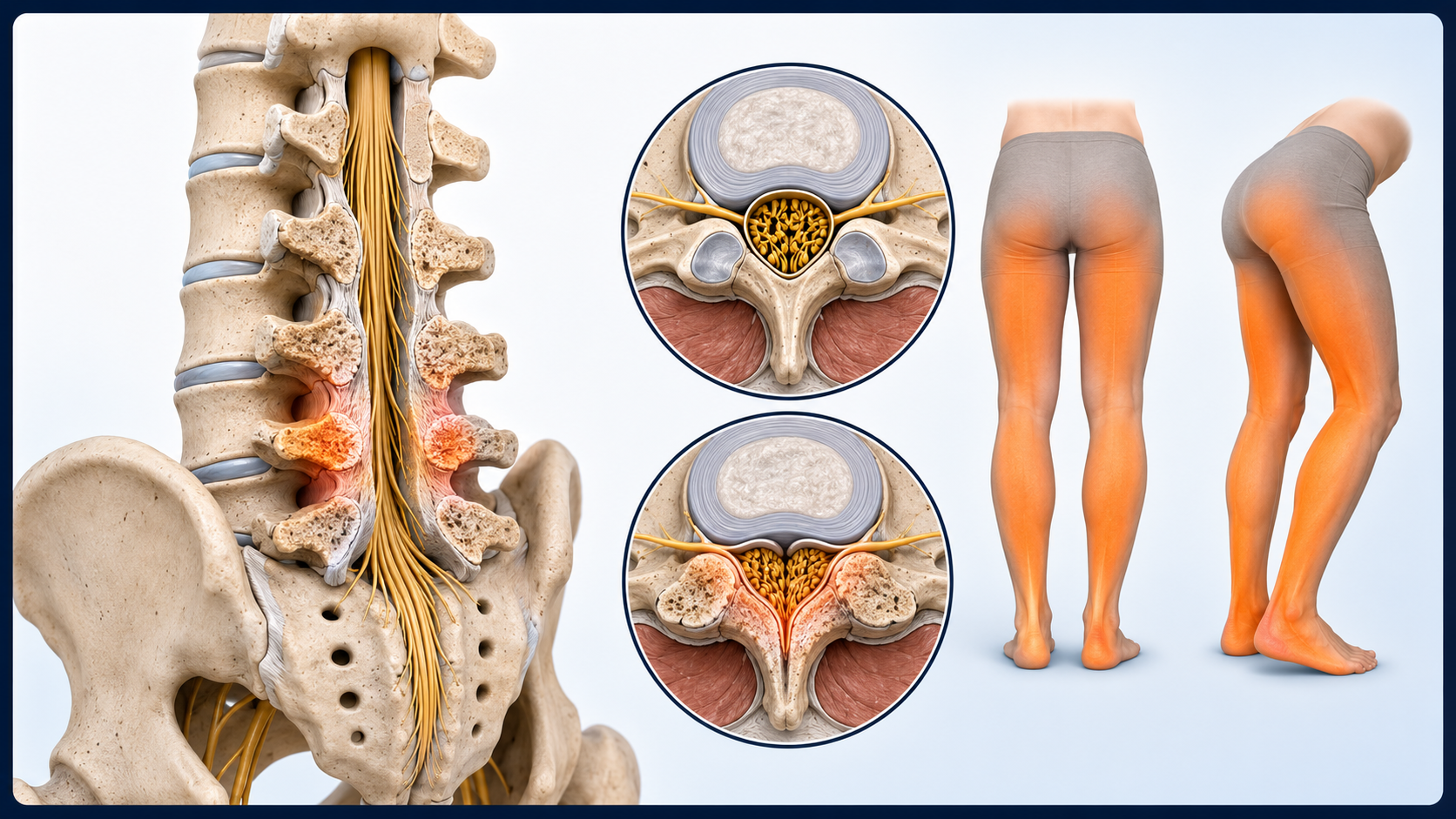
What this image shows
- Degenerative disc, facet-joint, and ligament changes reduce space in the lumbar spinal canal.
- The magnified cross-section shows crowding around the lumbar nerve roots.
- Symptoms often worsen with standing or walking and improve with sitting or bending forward.
What Causes Lumbar Spinal Stenosis
The spinal canal is the bony channel through which the spinal cord and nerve roots travel. In lumbar spinal stenosis, this canal narrows due to degenerative changes that accumulate over time: thickening of the ligamentum flavum, bone spur formation, disc bulging, and facet joint enlargement. These changes reduce the space available for the nerves.
The condition is most common in adults over 50 and typically develops gradually. Symptoms often worsen with standing and walking and improve with sitting or bending forward, because these positions temporarily increase the space available for the compressed nerves.
Neurogenic Claudication and the Shopping Cart Sign
Neurogenic claudication is the hallmark symptom of lumbar spinal stenosis. It describes leg pain, cramping, numbness, or weakness that builds with walking or prolonged standing and is relieved by sitting or bending forward. Unlike vascular claudication (caused by poor circulation), neurogenic claudication is caused by compression of the lumbar nerve roots and is not related to exertion level alone.
Many patients notice they can walk comfortably while leaning forward on a shopping cart or walker. This posture flexes the lumbar spine and temporarily opens the narrowed canal, providing relief. Clinicians refer to this as the "shopping cart sign" or "shopping cart relief for back pain" — and it is one of the most reliable indicators that lumbar spinal stenosis is the underlying cause of a patient's leg symptoms.
Common Symptoms
- Leg pain, cramping, or heaviness that worsens with walking or standing
- Relief when sitting, bending forward, or leaning on a shopping cart
- Numbness or tingling in the legs or feet
- Weakness in one or both legs
- Low back pain, often less prominent than leg symptoms
- Reduced walking distance over time (neurogenic claudication)
Treatment Options
Physical therapy
Targeted exercises to improve core stability and reduce mechanical load on the spinal canal.
Medications
Anti-inflammatory medications and neuropathic pain agents for symptom management.
Epidural steroid injections
Fluoroscopically guided injections to reduce inflammation around compressed nerve roots.
Endoscopic decompression
Surgical removal of the bone, ligament, or disc material narrowing the spinal canal, using minimally invasive endoscopic techniques.
Minimally invasive laminectomy
Muscle-sparing surgical decompression for patients with more extensive stenosis.
When Surgery Is Appropriate
Surgery is considered when conservative treatment has not provided adequate relief, when symptoms significantly limit daily activity, or when there is progressive neurological deficit such as worsening weakness. The goal of surgery is to remove the structural cause of nerve compression.
Dr. Blythe performs endoscopic lumbar decompression and minimally invasive spine surgery for appropriately selected patients. The specific technique is chosen based on the location and extent of stenosis, the patient's anatomy, and the overall clinical picture.
Schedule a Consultation
Call the office or submit a request online. We will follow up within one business day.