PRP for Rotator Cuff and Shoulder Conditions
PRP has been studied for rotator cuff tears, tendinopathy, and shoulder osteoarthritis. This article reviews the evidence and explains which patients may be appropriate candidates for evaluation.
PRP for Rotator Cuff and Shoulder Conditions
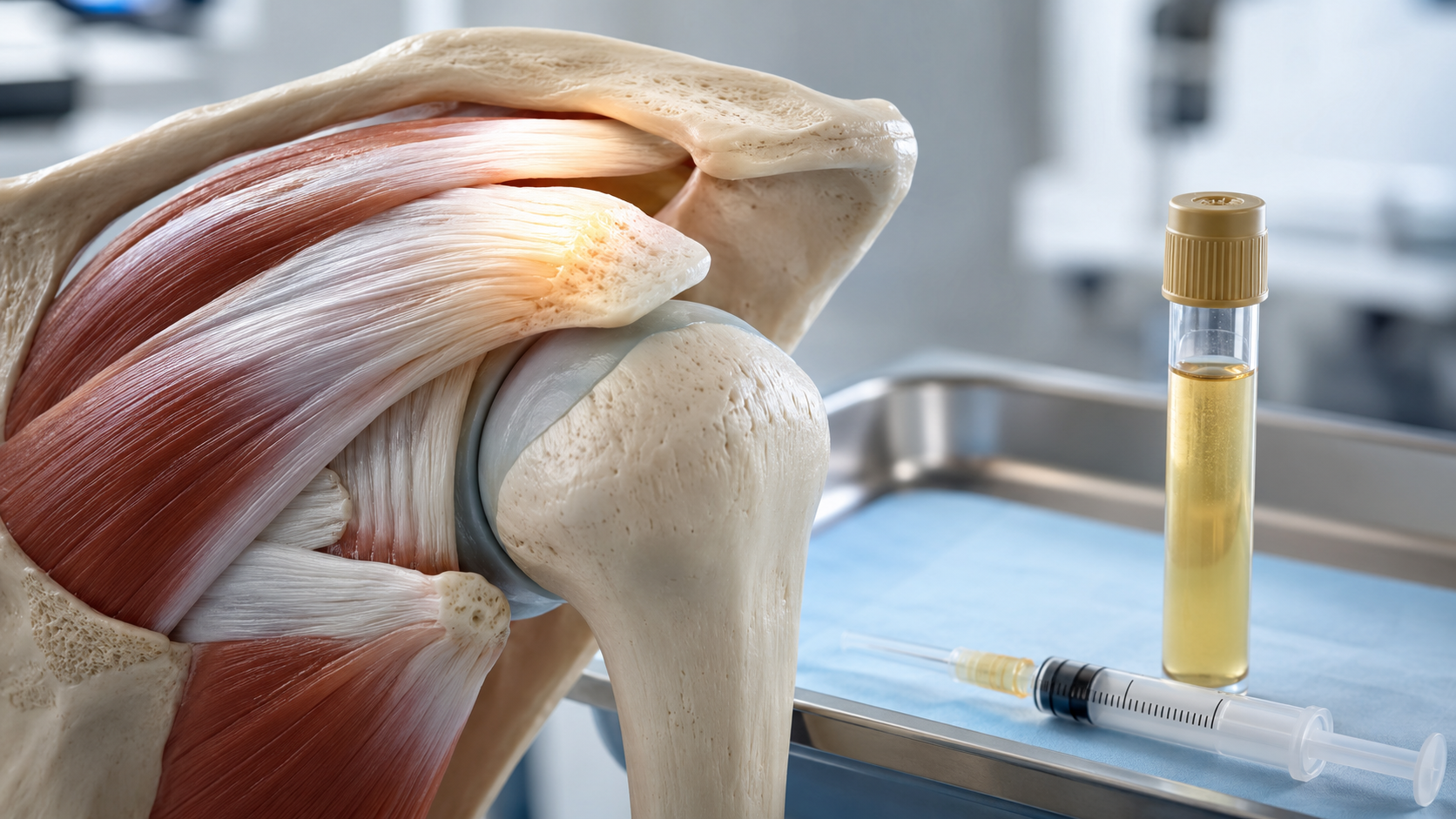
The shoulder is one of the more common sites for PRP evaluation in orthopedic practice. PRP has been studied as an adjunct to rotator cuff repair surgery, as a standalone injection for rotator cuff tendinopathy, and for glenohumeral osteoarthritis. The evidence varies by condition and is not uniformly positive.
PRP as an Adjunct to Rotator Cuff Repair Surgery
One of the more studied applications is the use of PRP at the time of rotator cuff repair surgery, with the goal of improving tendon-to-bone healing and reducing re-tear rates.
What the evidence shows: A 2019 systematic review and meta-analysis by Hurley et al. (Arthroscopy, 2019; DOI: 10.1016/j.arthro.2018.10.115) analyzed 19 randomized controlled trials involving 1,088 patients and found that PRP augmentation of rotator cuff repair did not significantly reduce re-tear rates or improve functional outcomes compared to repair alone. A 2021 meta-analysis by Vavken et al. similarly found no significant benefit for PRP augmentation in full-thickness rotator cuff repairs.
Contradictory evidence: Some smaller trials have found benefits in specific subgroups, particularly for medium-sized tears or when leukocyte-poor PRP was used. A 2015 randomized trial by Malavolta et al. (American Journal of Sports Medicine, 2014; DOI: 10.1177/0363546514541777) found no significant difference in re-tear rates at 24 months, but noted a trend toward lower re-tear rates in the PRP group for medium tears.
The current evidence does not support routine PRP augmentation for all rotator cuff repairs. It may be considered in selected cases based on tear size, tissue quality, and patient factors.
PRP for Rotator Cuff Tendinopathy
Rotator cuff tendinopathy — chronic degeneration of the tendon without a full-thickness tear — is a common source of shoulder pain. PRP has been studied as an alternative to corticosteroid injection.
What the evidence shows: A 2020 randomized controlled trial by Shams et al. (Orthopaedics and Traumatology: Surgery and Research, 2016; DOI: 10.1016/j.otsr.2016.06.006) compared PRP to corticosteroid injection for supraspinatus tendinopathy and found PRP superior at six months, with corticosteroid showing earlier but less durable improvement.
A 2021 systematic review by Puzzitiello et al. (Arthroscopy, 2021; DOI: 10.1016/j.arthro.2020.11.065) found that PRP produced better long-term outcomes than corticosteroid for rotator cuff tendinopathy, but noted that the evidence is of moderate quality and that short-term pain relief with corticosteroid may be preferable for some patients.
Limitations: Most trials in this area are small, use different PRP preparations, and have short follow-up periods. The evidence supports PRP as a reasonable option for selected patients with rotator cuff tendinopathy who have not responded to conservative treatment, but it does not establish PRP as a standard of care.
PRP for Glenohumeral Osteoarthritis
The evidence for PRP in glenohumeral (shoulder joint) osteoarthritis is limited compared to knee osteoarthritis. The shoulder joint is less commonly affected by primary osteoarthritis, and fewer randomized trials have been conducted.
A 2020 systematic review by Kirwan et al. found limited evidence supporting PRP for glenohumeral osteoarthritis, with most studies being small case series or retrospective reviews. Randomized controlled trial data is sparse. PRP for shoulder osteoarthritis may be considered in selected patients who are not surgical candidates or who wish to delay surgery, but the evidence base is weaker than for knee osteoarthritis.
Patient Selection
PRP for shoulder conditions is most appropriate for patients with:
- Rotator cuff tendinopathy that has not responded to physical therapy and other conservative treatments
- Partial-thickness rotator cuff tears in patients who are not surgical candidates or who prefer to avoid surgery
- Mild-to-moderate glenohumeral osteoarthritis in patients who are not surgical candidates
PRP is not a substitute for rotator cuff repair in patients with full-thickness tears who are appropriate surgical candidates. It does not reliably heal full-thickness tears or eliminate the need for surgery in patients who require it.
References
- Hurley ET, et al. Platelet-Rich Plasma Versus Corticosteroids for Rotator Cuff Tendinopathy. Arthroscopy. 2019;35(4):1151–1159. DOI: 10.1016/j.arthro.2018.10.115
- Malavolta EA, et al. Platelet-Rich Plasma in Rotator Cuff Repair. Am J Sports Med. 2014;42(10):2446–2454. DOI: 10.1177/0363546514541777
- Puzzitiello RN, et al. Adverse Impact of Corticosteroids on Rotator Cuff Tendon Health and Repair. Arthroscopy. 2021;37(2):523–532. DOI: 10.1016/j.arthro.2020.11.065
Reviewed by Joseph Blythe, DO — July 2026 Last medical review: July 31, 2026
Explore Topics

Written & reviewed by
Joseph Blythe, DO — Orthopedic Spine Surgeon
DO | Board-Certified Orthopedic Surgeon | Fellowship-Trained Spine Specialist
Dr. Blythe is a board-certified, fellowship-trained orthopedic and spine surgeon practicing in Oklahoma City. He completed his fellowship at the Spine Institute of Arizona and holds board certification through the American Osteopathic Board of Orthopedic Surgery (AOBO). All articles in the Patient Education Center are authored and medically reviewed by Dr. Blythe.