PRP for Knee Osteoarthritis: What the Evidence Shows
PRP has been studied more extensively for knee osteoarthritis than for most other orthopedic conditions. This article reviews the current evidence, including what it supports, where it falls short, and what professional societies recommend.
PRP for Knee Osteoarthritis: What the Evidence Shows
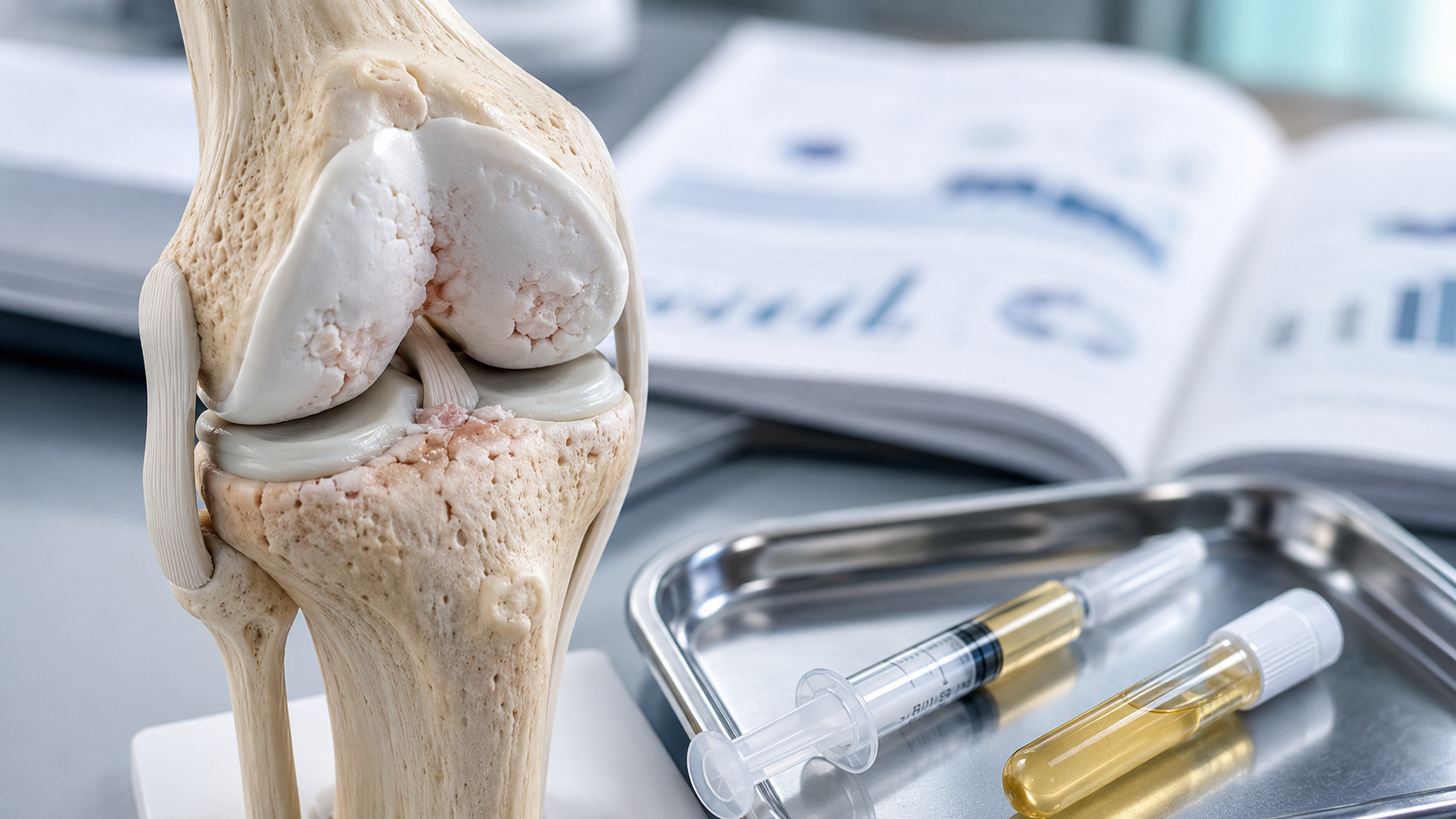
Knee osteoarthritis is the most studied orthopedic application for PRP. The evidence base is larger than for most other conditions, but it is not uniformly positive, and professional society recommendations remain inconsistent. Understanding what the evidence actually shows — including the negative trials — is essential for informed decision-making.
What Randomized Trials Show
Positive trials: Several randomized controlled trials have found PRP superior to placebo or hyaluronic acid for pain and function in mild-to-moderate knee osteoarthritis.
A 2015 randomized trial by Filardo et al. (Knee Surgery, Sports Traumatology, Arthroscopy, 2015; DOI: 10.1007/s00167-014-3113-4) compared PRP to hyaluronic acid in 192 patients and found no significant difference at 12 months, though both groups improved. A 2016 randomized trial by Montserrat et al. found PRP superior to hyaluronic acid at six months in patients with mild-to-moderate osteoarthritis.
A 2021 meta-analysis by Belk et al. (American Journal of Sports Medicine, 2021; DOI: 10.1177/03635465211007918) analyzed 18 randomized controlled trials and found leukocyte-poor PRP produced statistically significant improvements in pain and function compared to placebo and hyaluronic acid, with the strongest effects in patients with Kellgren-Lawrence grade 1–3 osteoarthritis.
Negative trials: The evidence is not uniformly positive. A 2021 randomized controlled trial by Bennell et al. (JAMA, 2021; DOI: 10.1001/jama.2021.19415) — one of the largest and most rigorous trials to date — compared a single PRP injection to saline placebo in 288 patients with symptomatic knee osteoarthritis. At 12 months, there was no significant difference in pain or function between groups. This trial used a leukocyte-rich preparation, which may partially explain the discrepancy with positive leukocyte-poor trials.
A 2022 Cochrane review by Dai et al. (Cochrane Database of Systematic Reviews, 2021; DOI: 10.1002/14651858.CD013342.pub2) concluded that PRP may reduce pain and improve function compared to placebo at three to 12 months, but that the evidence is of low to moderate certainty due to heterogeneity in preparations, protocols, and outcome measures.
Professional Society Recommendations
American Academy of Orthopaedic Surgeons (AAOS): The 2021 AAOS Clinical Practice Guideline on Osteoarthritis of the Knee gives PRP an "inconclusive" recommendation — meaning the evidence does not support a strong recommendation for or against its use. This is not a recommendation against PRP; it reflects the heterogeneity of the evidence.
Osteoarthritis Research Society International (OARSI): The 2019 OARSI guidelines do not include PRP as a recommended treatment for knee osteoarthritis, citing insufficient evidence. However, the guidelines acknowledge that the evidence base is evolving.
American College of Rheumatology (ACR): The 2019 ACR guidelines conditionally recommend against PRP for knee osteoarthritis, based on the evidence available at the time of publication. Subsequent positive trials have not yet been incorporated into an updated guideline.
Who Is Most Likely to Benefit
The available evidence suggests that patients most likely to benefit from PRP for knee osteoarthritis are those with:
- Mild-to-moderate osteoarthritis (Kellgren-Lawrence grade 1–3)
- Younger age and lower BMI
- Absence of inflammatory arthritis
- Prior failure of conservative treatments (physical therapy, NSAIDs, corticosteroid injections)
Patients with advanced osteoarthritis (grade 4), inflammatory arthritis, or significant mechanical deformity are less likely to respond and may be better served by surgical evaluation.
What PRP Does Not Do
PRP does not reliably regrow normal articular cartilage. It does not reverse advanced osteoarthritis. It does not eliminate the need for surgery in patients who are appropriate surgical candidates. Claims that PRP "regenerates" cartilage or "reverses" arthritis are not supported by the current human clinical evidence.
Limitations of the Evidence
The PRP literature for knee osteoarthritis is limited by:
- Preparation heterogeneity. Studies use different systems, platelet concentrations, leukocyte contents, and activation methods. Results from one system cannot be directly applied to another.
- Outcome measure variability. Studies use different patient-reported outcome measures, making direct comparison difficult.
- Short follow-up. Most trials follow patients for 12 months or less. Long-term data beyond two years is limited.
- Industry funding. Some positive trials have industry funding, which is a recognized source of bias in the PRP literature.
References
- Belk JW, et al. Leukocyte-Poor Platelet-Rich Plasma Is Superior to Leukocyte-Rich Platelet-Rich Plasma for the Treatment of Knee Osteoarthritis. Am J Sports Med. 2021;49(9):2598–2607. DOI: 10.1177/03635465211007918
- Bennell KL, et al. Effect of Intraarticular Platelet-Rich Plasma vs Placebo Injection on Pain and Medial Tibial Cartilage Volume in Patients With Knee Osteoarthritis. JAMA. 2021;326(20):2021–2030. DOI: 10.1001/jama.2021.19415
- Dai WL, et al. Efficacy of Platelet-Rich Plasma in the Treatment of Knee Osteoarthritis. Cochrane Database Syst Rev. 2021;(6):CD013342. DOI: 10.1002/14651858.CD013342.pub2
- Filardo G, et al. Platelet-Rich Plasma vs Hyaluronic Acid to Treat Knee Degenerative Pathology. Knee Surg Sports Traumatol Arthrosc. 2015;23(9):2700–2706. DOI: 10.1007/s00167-014-3113-4
Reviewed by Joseph Blythe, DO — July 2026 Last medical review: July 31, 2026
Explore Topics

Written & reviewed by
Joseph Blythe, DO — Orthopedic Spine Surgeon
DO | Board-Certified Orthopedic Surgeon | Fellowship-Trained Spine Specialist
Dr. Blythe is a board-certified, fellowship-trained orthopedic and spine surgeon practicing in Oklahoma City. He completed his fellowship at the Spine Institute of Arizona and holds board certification through the American Osteopathic Board of Orthopedic Surgery (AOBO). All articles in the Patient Education Center are authored and medically reviewed by Dr. Blythe.