PRP for Hip Pain: Diagnosis and Injection Accuracy Matter
Hip pain has multiple causes, and accurate diagnosis is essential before PRP is considered. This article explains why diagnosis and injection technique are particularly important for hip-region PRP, and what the evidence shows.
PRP for Hip Pain: Diagnosis and Injection Accuracy Matter
Hip pain is not a diagnosis — it is a symptom with many possible causes. Before PRP is considered for any hip-region condition, an accurate diagnosis is essential. Treating the wrong structure with PRP will not produce meaningful improvement, and may delay appropriate treatment.
Why Diagnosis Matters More for the Hip Than for the Knee
The knee is a relatively straightforward joint to evaluate and inject. The hip is more complex. Pain perceived in the hip region may originate from:
- The glenohumeral joint (true hip joint osteoarthritis or labral pathology)
- The greater trochanteric bursa or gluteal tendons (greater trochanteric pain syndrome)
- The sacroiliac joint
- The lumbar spine (referred pain from L3–L4 nerve roots)
- The iliopsoas tendon or bursa
- Femoroacetabular impingement (FAI)
Each of these conditions has a different treatment approach. PRP injected into the hip joint will not address greater trochanteric pain syndrome, and PRP injected into the bursa will not address intra-articular pathology. A thorough history, physical examination, and appropriate imaging — including X-ray and often MRI — are required before PRP is recommended.
Injection Accuracy for Intra-Articular Hip Procedures
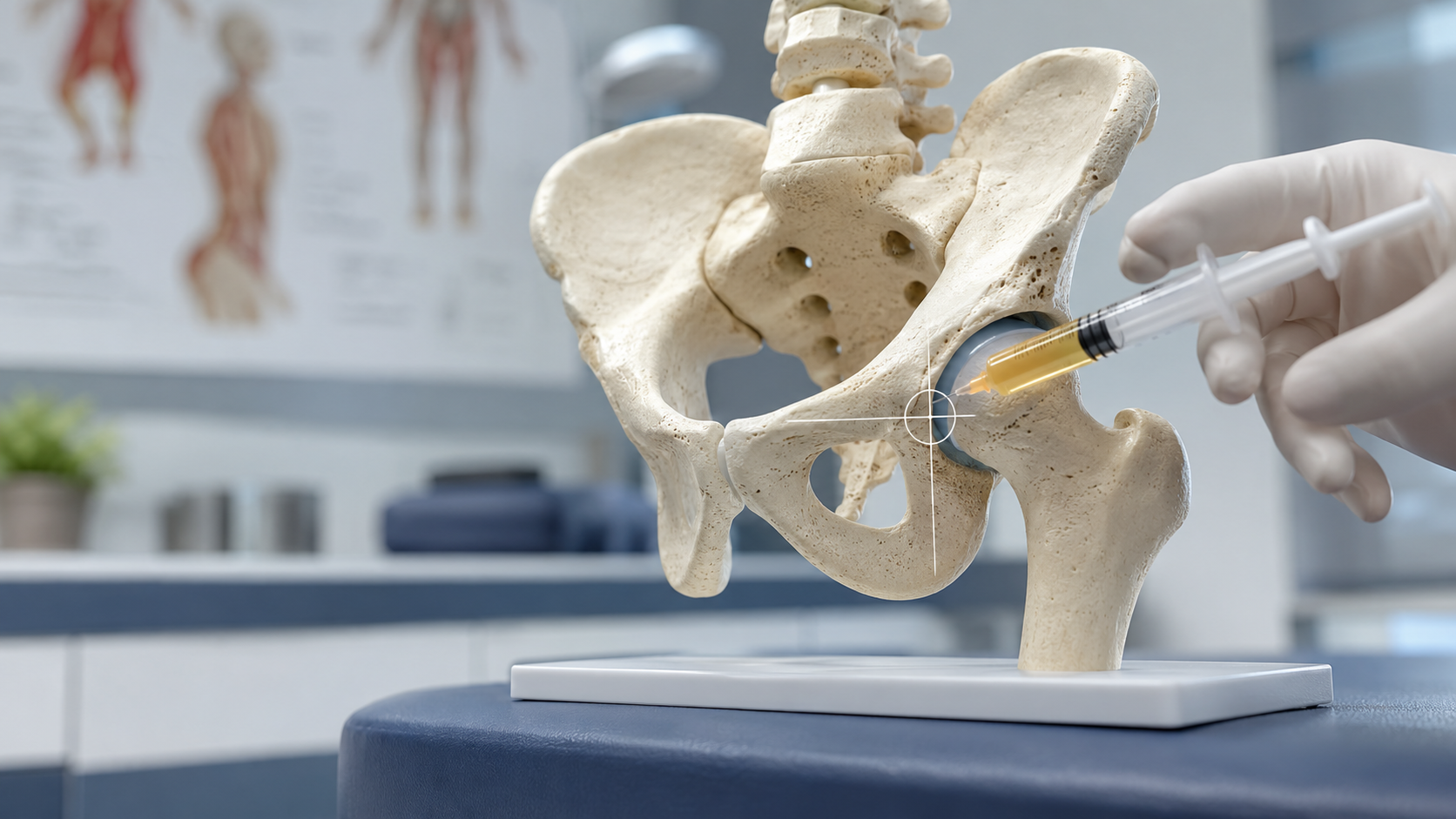
The hip joint is a deep structure surrounded by significant soft tissue. Landmark-guided injection accuracy for the hip joint is substantially lower than for the knee. Studies have shown that landmark-guided hip injections miss the joint in 20–40% of cases, depending on the patient's body habitus and the injector's experience.
For intra-articular hip PRP, image guidance — fluoroscopy or ultrasound — is generally recommended to confirm needle placement. At this practice, intra-articular hip procedures that require image guidance are scheduled at a surgery center with fluoroscopic capability. This is not a limitation of the treatment; it is a quality standard that ensures the PRP is delivered to the intended target.
Evidence for PRP in Hip Osteoarthritis
The evidence base for PRP in hip osteoarthritis is smaller than for knee osteoarthritis, but several studies have been published.
What the evidence shows: A 2018 randomized controlled trial by Dallari et al. (Clinical Orthopaedics and Related Research, 2016; DOI: 10.1007/s11999-015-4608-9) compared PRP to hyaluronic acid and saline in 111 patients with hip osteoarthritis. At 12 months, the PRP group had significantly better outcomes on the Harris Hip Score and VAS pain scale compared to both comparators.
A 2021 systematic review by Shen et al. (Journal of Orthopaedic Surgery and Research, 2021; DOI: 10.1186/s13018-021-02260-5) analyzed six randomized controlled trials and found PRP superior to hyaluronic acid for hip osteoarthritis at six and 12 months, with a favorable safety profile.
Limitations: The evidence base for hip PRP is smaller than for the knee, most trials are of moderate quality, and follow-up beyond 12 months is limited. The evidence supports PRP as a reasonable option for selected patients with mild-to-moderate hip osteoarthritis, but it does not establish PRP as a standard of care.
Evidence for PRP in Greater Trochanteric Pain Syndrome
Greater trochanteric pain syndrome (GTPS) — which includes gluteal tendinopathy and trochanteric bursitis — is a common cause of lateral hip pain. PRP has been studied as an alternative to corticosteroid injection.
A 2018 randomized controlled trial by Fitzpatrick et al. (British Journal of Sports Medicine, 2019; DOI: 10.1136/bjsports-2018-099567) compared PRP to corticosteroid injection in 80 patients with GTPS. At 12 months, the PRP group had significantly better outcomes, with corticosteroid showing earlier but less durable improvement. This pattern — corticosteroid superior short-term, PRP superior long-term — mirrors findings in other tendon conditions.
What PRP Does Not Do for Hip Pain
PRP does not repair labral tears, correct femoroacetabular impingement, or address structural causes of hip pain that require surgical intervention. Patients with significant labral pathology, advanced osteoarthritis, or FAI who are appropriate surgical candidates should be evaluated for surgery rather than PRP.
References
- Dallari D, et al. Ultrasound-Guided Injection of Platelet-Rich Plasma and Hyaluronic Acid, Separately and in Combination, for Hip Osteoarthritis. Clin Orthop Relat Res. 2016;474(11):2395–2405. DOI: 10.1007/s11999-015-4608-9
- Fitzpatrick J, et al. Leucocyte-Rich Platelet-Rich Plasma Treatment of Gluteus Medius and Minimus Tendinopathy. Br J Sports Med. 2019;53(10):630–637. DOI: 10.1136/bjsports-2018-099567
- Shen L, et al. The Efficacy and Safety of Platelet-Rich Plasma Injection for Hip Osteoarthritis. J Orthop Surg Res. 2021;16(1):136. DOI: 10.1186/s13018-021-02260-5
Reviewed by Joseph Blythe, DO — July 2026 Last medical review: July 31, 2026
Explore Topics

Written & reviewed by
Joseph Blythe, DO — Orthopedic Spine Surgeon
DO | Board-Certified Orthopedic Surgeon | Fellowship-Trained Spine Specialist
Dr. Blythe is a board-certified, fellowship-trained orthopedic and spine surgeon practicing in Oklahoma City. He completed his fellowship at the Spine Institute of Arizona and holds board certification through the American Osteopathic Board of Orthopedic Surgery (AOBO). All articles in the Patient Education Center are authored and medically reviewed by Dr. Blythe.