
Lumbar Fusion Surgery
LLIF Lateral Lumbar Interbody Fusion in Oklahoma City
Lateral lumbar interbody fusion is a lumbar reconstruction technique performed through the patient's side, providing access to the disc space without the extensive posterior muscle dissection required by traditional open posterior approaches.
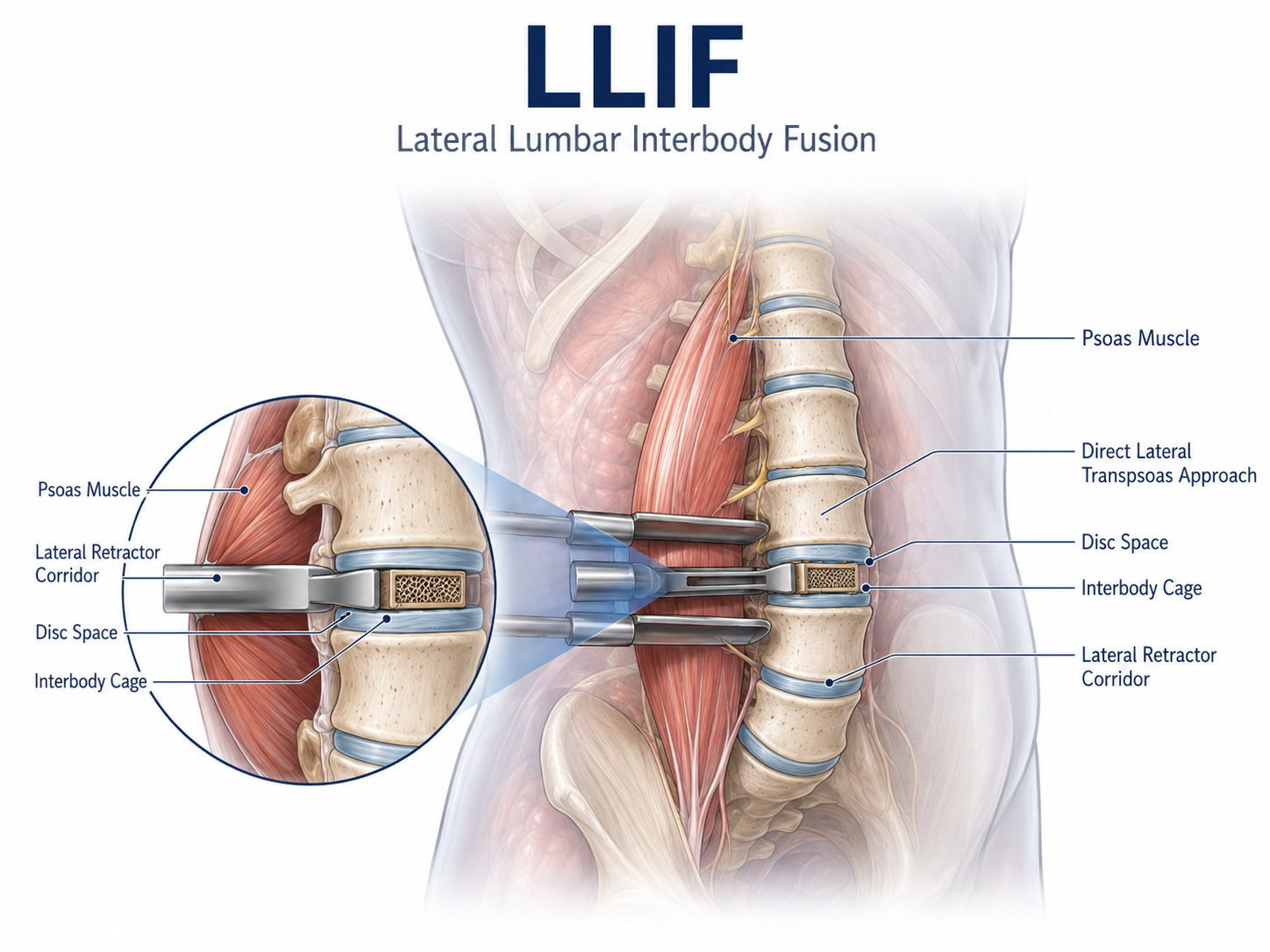
How LLIF Works
Lateral lumbar interbody fusion, commonly called LLIF, is a lumbar reconstruction technique performed through the patient's side. The approach provides access to the disc space without the extensive posterior muscle dissection required by traditional open posterior approaches.
Dr. Joseph Blythe uses lateral fusion selectively as part of a broader range of lumbar fusion techniques. The approach is chosen only when the patient's anatomy and pathology make it the appropriate route.
The surgeon reaches the disc space through a lateral retroperitoneal approach. In a standard transpsoas LLIF, the operative corridor passes through the psoas muscle. Neuromonitoring is commonly used to help identify a safe pathway relative to the lumbar plexus.
The damaged disc is removed and the disc space is reconstructed with a broad interbody implant and bone-graft material. Restoring disc height can improve alignment and increase the dimensions of the neural foramina.
Conditions LLIF May Treat
- Degenerative disc disease
- Spondylolisthesis
- Degenerative scoliosis
- Disc-space collapse
- Foraminal stenosis
- Adjacent-segment degeneration
- Selected multilevel lumbar reconstruction
Advantages of the Lateral Corridor
- Avoids extensive posterior muscle stripping
- Provides broad access to the disc space
- Allows placement of a large-footprint interbody implant
- Can restore disc and foraminal height
- Can assist in correction of selected spinal deformity
Why Anatomy Determines the Approach
The iliac crest, psoas muscle, lumbar plexus, location of the target disc and the level being treated all influence whether a safe lateral corridor exists.
Some levels are considerably more difficult to reach laterally because of the pelvis and surrounding neural anatomy. When the lateral route does not provide the safest or most complete solution, another approach is selected.
LLIF Is Not Automatically Better
A smaller incision does not make an operation better if it does not adequately address the pathology. The objective is complete decompression, reconstruction and stabilization with the least unnecessary disruption of normal anatomy.
Frequently Asked Questions
- What is the difference between LLIF and OLIF?
- LLIF typically passes through the psoas muscle from a directly lateral position. OLIF approaches the disc anterior to the psoas through an oblique corridor. Both provide powerful disc-space reconstruction, but their anatomy, neurologic considerations and accessible levels differ.
- Is neuromonitoring used during LLIF?
- Yes. Neuromonitoring is commonly used during LLIF to help identify a safe pathway through the psoas muscle relative to the lumbar plexus.
- Can LLIF treat degenerative scoliosis?
- LLIF can be a useful component of a surgical plan for selected patients with degenerative scoliosis, particularly when multilevel disc-space reconstruction and alignment correction are objectives.
- How does Dr. Blythe decide whether LLIF is appropriate?
- The decision is based on the patient's anatomy, the level being treated, the psoas position, the iliac crest anatomy, the lumbar plexus location and the type of reconstruction required. If the lateral corridor is not safe or does not adequately address the pathology, another approach is selected.
Medically reviewed by Joseph R. Blythe, DO
Board-Certified Orthopedic Surgeon · Fellowship-Trained Spine Surgeon · Last reviewed: August 2026
Schedule a Consultation
Call the office directly or submit an appointment request online. We will follow up within one business day.