
Lumbar Fusion Surgery
ALIF Anterior Lumbar Interbody Fusion in Oklahoma City
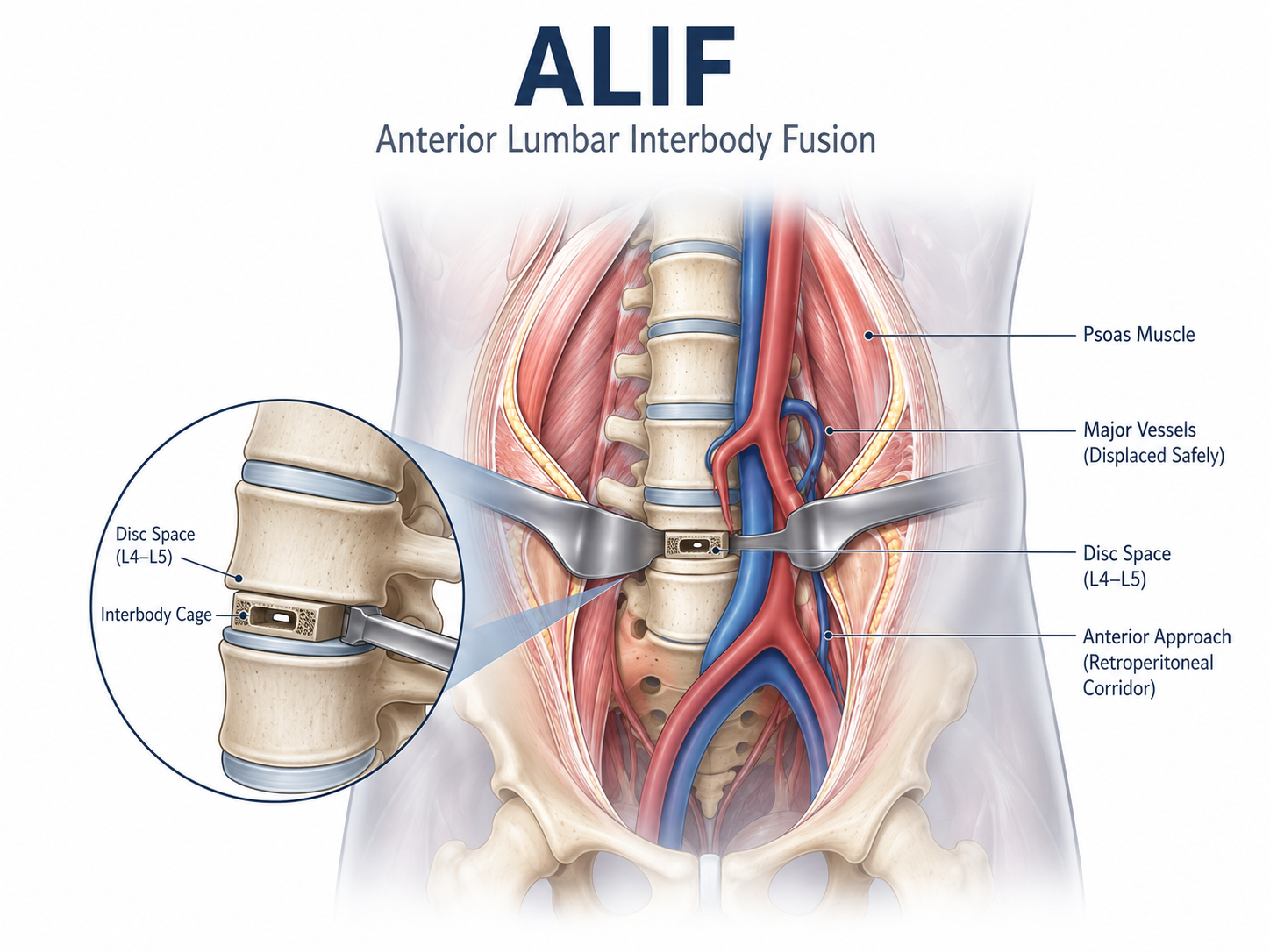
Anterior lumbar interbody fusion approaches the spine from the front of the body, providing direct access to the lumbar disc space while avoiding disruption of the posterior spinal muscles.
What Is an ALIF?
Anterior lumbar interbody fusion, or ALIF, is a lumbar fusion technique that approaches the spine from the front of the body rather than through the muscles of the back. For appropriately selected patients, this approach provides direct access to the lumbar disc space and allows placement of a large interbody implant while avoiding unnecessary disruption of the posterior spinal muscles.
During ALIF, the lumbar spine is approached through the abdomen. The affected disc is removed and the disc space is reconstructed with an interbody implant containing bone-graft material. Restoring disc height can improve alignment, enlarge the space available for the exiting nerves and provide a broad surface area for fusion.
Depending on the condition being treated, supplemental fixation may also be used to provide additional stability while fusion develops.
Dr. Joseph Blythe is a board-certified orthopedic surgeon and fellowship-trained spine surgeon in Oklahoma City. He selects the surgical approach according to the patient's anatomy, pathology, bone quality, prior surgery and the goals of reconstruction. ALIF is one option among several lumbar fusion techniques and is not the right approach for every patient.
Conditions ALIF May Be Used to Treat
- Degenerative disc disease
- Lumbar spondylolisthesis
- Disc-space collapse
- Foraminal stenosis associated with loss of disc height
- Segmental instability
- Selected revision fusion cases
- Selected spinal deformity or alignment problems
Why Use an Anterior Approach?
ALIF provides broad access to the disc space without dissecting through the posterior lumbar muscles. A large interbody implant can be placed across the vertebral endplates, permitting substantial restoration of disc height and segmental alignment when appropriate.
The approach can be particularly useful when the surgical objective includes reconstruction of a collapsed disc space or restoration of lumbar alignment. The potential advantage of the approach depends entirely on the patient's anatomy and the problem being corrected.
When ALIF May Not Be the Best Approach
ALIF requires a safe pathway to the lumbar spine around major abdominal and vascular structures. Prior abdominal surgery, vascular anatomy, scar tissue, bone quality, the level being treated and other patient-specific factors may make another approach safer or more effective.
Dr. Blythe does not force a particular approach simply because it is minimally invasive or technically possible. The goal is to choose the safest approach that completely addresses the structural problem.
ALIF vs. OLIF vs. LLIF vs. TLIF
These procedures all reconstruct the lumbar disc space, but they reach it from different directions. ALIF approaches from the front, , OLIF through an oblique retroperitoneal corridor, LLIF through a lateral approach, and TLIF from the posterior portion of the spine.
There is no universally superior approach. The correct operation depends on spinal level, vascular anatomy, iliac crest anatomy, nerve location, previous surgery, bone quality, deformity and the type of decompression or stabilization required.
Recovery After ALIF
Recovery varies according to the number of levels treated, whether posterior fixation or decompression is also performed, the patient's general health and the underlying diagnosis. Walking generally begins early after surgery, with activity advanced according to healing and the specific reconstruction performed.
Frequently Asked Questions
- Is ALIF minimally invasive?
- ALIF avoids the posterior lumbar muscle dissection required by some traditional posterior procedures. Whether it is considered the least disruptive option depends on the patient's anatomy and the complete operation required.
- Does ALIF require posterior screws?
- Sometimes. Supplemental fixation is determined by the pathology, stability, bone quality, number of levels treated and implant construct.
- Can ALIF treat spondylolisthesis?
- ALIF can be useful in selected patients with spondylolisthesis when restoration of disc height, alignment and stability are important surgical objectives.
- How does Dr. Blythe decide which fusion approach to use?
- The decision is based on the actual pathology and patient anatomy. Imaging, neurologic findings, spinal alignment, bone quality, vascular anatomy, previous surgery and treatment goals are considered before choosing the operative corridor.
Medically reviewed by Joseph R. Blythe, DO
Board-Certified Orthopedic Surgeon · Fellowship-Trained Spine Surgeon · Last reviewed: August 2026
Schedule a Consultation
Call the office directly or submit an appointment request online. We will follow up within one business day.